
SUMMARY
This article provides guidance on what to do if a Nuke script has become very heavy and slow to navigate.
MORE INFORMATION
If a script has become slow or unresponsive then we would recommend you do the following to either try and diagnose the causes of the slowness, or try to improve the current performance:
TROUBLESHOOTING
Test the script in safe mode:
Testing the script in safe mode may help you identify whether the issue might be related to a customization/third party plug-in you're using, or Nuke itself. The following article provides instructions for how to launch Nuke in safe mode:
Q100038: Launching Nuke/NukeX/Nuke Studio/Hiero in safe mode
Test with Script Profiling enabled:
This helps you see the total processing time spent on each node and identify a potential culprit. The processing time spent on each node is shown as: Red = slow nodes, Green = fast nodes
To launch Nuke with script profiling enabled you need to add the -P argument when launching from the terminal/command prompt:
Windows: C:\Program Files\Nuke17.1v1\Nuke17.1.exe -P
macOS: /Applications/Nuke17.1v1/Nuke17.1v1.app/Contents/MacOS/Nuke17.1 -P
Linux: /usr/local/Nuke17.1v1/Nuke17.1 -P
For any nodes that appear red, we would recommend you first try disabling them to see if the script speeds up, and then gradually enabling again with lower settings.
For more information, please reference Nuke's online documentation regarding script profiling.
As of Nuke 11.1v1 and later, we introduced the Profile node. This node allows users the ability to calculate the metrics of a node tree at the point the Profile node is placed. More information about this node can be found in the Profile node and Using Visual Diagnostics sections of Nuke's online documentation.
When a Profile node is placed in the Node Graph and selected, the Profile menu will open:
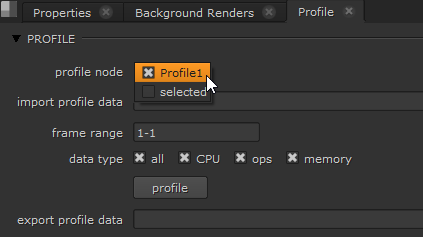
To begin profiling, enter the selected frame range and data type, then click the profile knob to execute it.
Once the data is collected, within the Profile menu, the data will be generated and shown in a chart based upon percentage use. For more information on filtering this data, please refer to the Filtering Profile Data documentation.
You can find information on how to use Profiling to isolate performance issues in the following article:
Q100225: Profiling your Nuke script to isolate performance issues
IMPROVING PERFORMANCE
Disabling thumbnails or setting static frames:
Disabling thumbnails, or setting them to static frames, may help reduce the amount of processing happening within the script. You can find more information about this in the following article:
Use Precomp nodes:
By using the Precomp node you can save a subset of the node tree as a separate .nk script, render the output of this saved script, and read the rendered output back into the main comp as a single image input.
This speeds up render time, as Nuke only has to process the single image input instead of all the nodes that were used to create it.
For more information, please reference Nuke's online documentation regarding the Precomp node.
We're sorry to hear that
Please tell us why